

Key Takeaways
Start here
Why dried legumes belong in your weekly rotation
Next
Selecting and storing dried beans and lentils
Then
Soaking and cooking basics
Put it to use
Family-friendly meal ideas
Why dried legumes belong in your weekly rotation
Dried beans and lentils are not exciting pantry items, but they are hard to beat on cost, nutrition, and shelf life. A one-pound bag of dry pinto beans typically costs under a dollar and produces roughly six cups of cooked beans. That same amount of protein from ground beef costs several times more. Families looking for practical ways to stretch grocery spending, like the approach outlined in feeding a family of four on a weekly food budget, often find legumes do a lot of the heavy lifting.
Nutritionally, dried beans and lentils supply protein, dietary fiber, iron, folate, magnesium, and potassium. A half-cup serving of cooked black beans has roughly 7 to 8 grams of protein and about 7 grams of fiber. Fiber slows digestion, which means a bean-based meal keeps people feeling full longer than a comparable serving of many processed proteins.
This article is general food and nutrition information, not medical or dietary advice. Consult a qualified healthcare professional for guidance specific to your family's health needs.
Legume
A plant whose seeds grow in pods. Beans, lentils, peas, and chickpeas are all legumes. The seeds are edible and high in protein and fiber.
Oligosaccharides
A type of carbohydrate found in beans that the human gut cannot fully digest. They pass to the large intestine where bacteria ferment them, sometimes causing gas or bloating.
Complete protein
A protein source that contains adequate amounts of all nine essential amino acids the body cannot produce on its own. Legumes are not complete proteins alone but become nutritionally complete when combined with grains over the course of the day.
Phytohaemagglutinin
A naturally occurring compound concentrated in raw kidney beans. At high levels it causes nausea and vomiting. A full rolling boil for at least ten minutes destroys it.
Quick soak
A fast alternative to overnight soaking for dried beans. Beans are boiled for two minutes, then left to sit in the hot water for one hour before being drained and cooked.
Selecting and storing dried beans and lentils
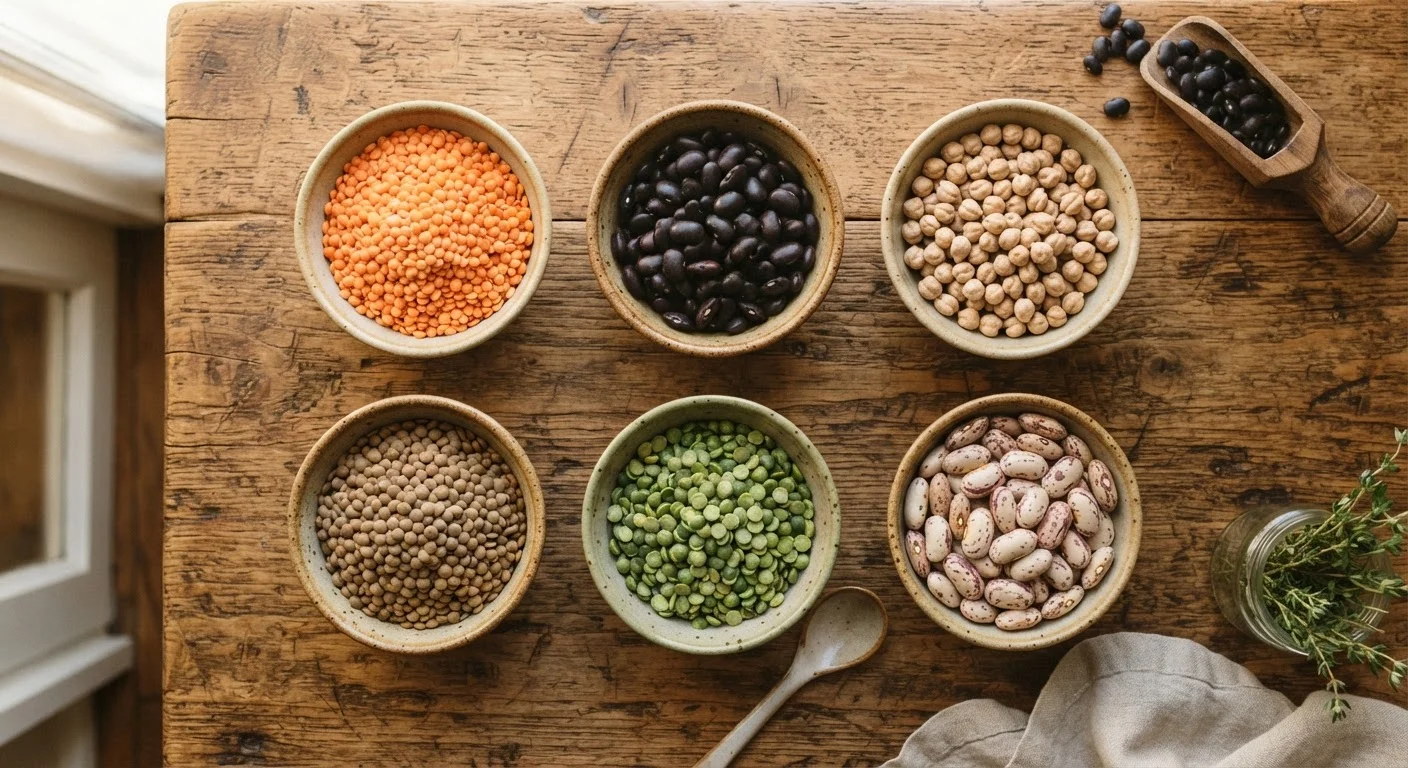
Most grocery stores stock a workable range: black beans, pinto beans, navy beans, chickpeas (also called garbanzo beans), red kidney beans, green or brown lentils, red lentils, and split peas. Buying in bulk bins, when available, costs less per pound than pre-bagged options. Either way, check that the beans look uniform in color and are free of visible cracks or shriveling, which can signal age.
Storage is straightforward. Transfer beans from the bag into an airtight glass or plastic container and keep them in a cool, dry place away from direct sunlight. Under these conditions, dried beans stay usable for one to two years. Lentils and split peas hold for a similar period. Older beans are not unsafe to eat, but they take longer to soften and may never fully tenderize, so rotating stock matters. Legumes fit neatly into the category of pantry staples that give real value per dollar because they sit on the shelf until you need them.
Soaking and cooking basics
Lentils and split peas need no soaking. Rinse them, add to a pot with water at roughly a 1:3 ratio (one cup lentils to three cups water), and simmer. Red lentils cook in 15 to 20 minutes and break down into a thick texture good for soups and dals. Green and brown lentils hold their shape better and take 25 to 35 minutes.
Most dried beans benefit from soaking to shorten cook time and improve texture. The overnight method is simple: cover beans with several inches of cold water and leave them for eight to twelve hours. Drain, rinse, cover with fresh water, and simmer until tender, which usually takes 45 to 90 minutes depending on variety. The quick-soak method works when time is short: bring beans and water to a boil for two minutes, turn off the heat, let sit for one hour, then drain and cook.
Kidney beans require a safety step. They contain a naturally occurring compound called phytohaemagglutinin at levels that cause digestive illness if the beans are not boiled properly. Boil kidney beans on the stovetop at a full rolling boil for at least ten minutes before simmering or adding them to a slow cooker. This step is not optional.
Season beans at the right time
Salt and acidic ingredients like tomatoes or vinegar can toughen bean skins if added too early in cooking. Wait until the beans are fully tender before adding these ingredients. A pinch of baking soda added to the soaking water can help soften older beans that resist tenderizing.
Salt and acidic ingredients like tomatoes or vinegar can toughen bean skins if added too early. Add them once the beans are tender, near the end of cooking.
Family-friendly meal ideas
A pot of cooked beans or lentils at the start of the week opens several meal paths with minimal extra work. Here are practical starting points:
- Black bean tacos: Warm cooked black beans with cumin, garlic powder, and a splash of water. Serve in corn tortillas with shredded cabbage and salsa.
- Lentil soup: Saute onion, carrot, and celery, add green lentils and broth, and simmer for 30 minutes. Add a can of diced tomatoes and salt to finish.
- White bean pasta: Toss cooked cannellini beans with pasta, olive oil, garlic, and spinach for a meal that comes together in under 20 minutes.
- Chickpea grain bowls: Roast chickpeas in the oven with olive oil and paprika until crisp. Serve over rice or farro with a simple yogurt sauce.
- Split pea soup: Simmer dried split peas with diced onion, carrot, and a smoked ham hock or smoked paprika for a filling, low-cost cold-weather meal.
Batch cooking is the most practical approach for busy households. Cook a large pot on Sunday, portion into containers, and refrigerate or freeze. Frozen cooked beans thaw quickly and work well added directly to soups or stir-fries. Combining this habit with broader strategies covered in reducing grocery costs without cutting nutritional quality can produce noticeable savings over a month.