

Key Takeaways
Why pantry depth matters more than weekly variety
Most grocery overspending happens at the margins: the last-minute convenience purchase, the ingredient bought for one recipe and never used again, the fresh produce that goes soft before Thursday. A reliable pantry does not eliminate those decisions, but it does reduce how often you face them. When the baseline is already covered, the weekly shop becomes a shorter, cheaper list.
The staples below are chosen by three criteria: shelf stability (meaning months, not days), nutritional density, and cooking flexibility. Each one can anchor multiple meals across a week without repetition feeling forced. If you are working toward a weekly grocery target, see how a family of four can structure meals around a $150 weekly budget for a framework that puts these staples to work.
Dried lentils
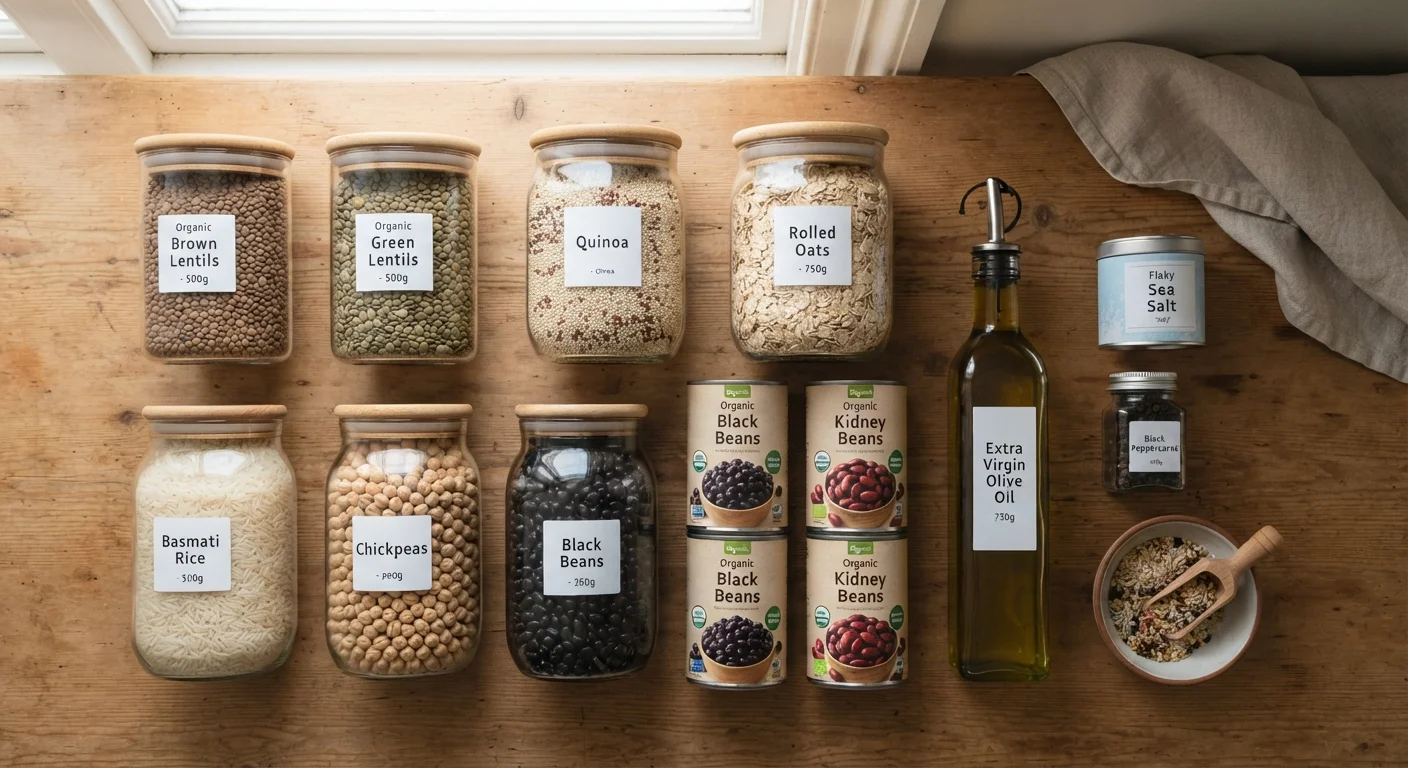
Lentils are among the most protein-dense foods available at grocery stores, and they cost a fraction of what meat costs per gram of protein. A one-pound bag typically yields six to eight servings. Unlike dried beans, lentils do not require soaking, which shortens the gap between pantry and plate considerably.
Red lentils break down into thick soups and dahls. Green and brown lentils hold their shape for salads, grain bowls, and tacos. The iron and fiber content makes them a useful nutritional anchor for plant-heavy meal plans. Cutting grocery costs without sacrificing nutrition covers how legumes like lentils fit into a broader strategy for keeping food budgets realistic.
Lentils require no soaking and deliver more protein per dollar than most grocery store proteins.
Canned beans (black, kidney, chickpeas)
Canned beans trade some cost efficiency versus dried, but they pay back in speed and convenience. A can of chickpeas can go from shelf to plate in under ten minutes. Across a busy week with multiple people eating at different times, that matters. Buying store-brand canned beans, compared to national brands, typically costs 20 to 40 percent less for an identical product.
Rotate at least two varieties to avoid the same flavor profile every night. Black beans work in rice dishes and wraps. Kidney beans are a natural fit for soups and chili. Chickpeas go into curries, roasted snacks, and pasta dishes. Each variety covers different flavor territory from the same shelf position.
Store-brand canned beans can cost 20 to 40 percent less than national brands for the same product.
Rolled oats
Rolled oats are the lowest-cost, most flexible breakfast grain in the American supermarket. A standard 42-ounce canister covers roughly 30 half-cup servings, which translates to several weeks of breakfasts at well under fifty cents per meal. They also go into baked goods, meatball binders, and homemade granola bars, which extends their usefulness past morning.
Old-fashioned rolled oats and quick oats are interchangeable in most cooked applications. Steel-cut oats take longer but have a lower glycemic index. For a family, plain rolled oats with add-ins (fruit, peanut butter, honey) are cheaper than any flavored packet variety and produce less packaging waste.
A large canister of rolled oats can cover several weeks of family breakfasts for well under fifty cents per serving.
Long-grain white or brown rice
Rice is the backbone of more cuisines worldwide than any other grain, and its shelf life of two or more years makes it a reliable long-term pantry investment. A five-pound bag of long-grain white rice yields approximately 25 cups of cooked rice. Brown rice takes longer to cook but adds fiber and a nuttier flavor to the same base recipes.
Rice works as a side dish, a bowl base, a soup filler, and a fried rice vehicle for leftover vegetables and proteins. The cost per serving is low enough that rice functions as a meal extender: adding it to a dish with a small amount of protein can stretch that protein across an additional two or three servings without the meal feeling thin.
A five-pound bag of long-grain rice yields around 25 cups of cooked grain, stretching meals across most of the week.
Canned whole or crushed tomatoes
Canned tomatoes do something no fresh tomato in January can do: deliver consistent flavor at a predictable price regardless of season. They form the base for pasta sauces, soups, braises, shakshuka, chili, and curries. A single 28-ounce can typically covers a sauce for four people.
Whole canned tomatoes give you control over texture because you can crush them by hand or with a spoon to the consistency a dish needs. Crushed tomatoes save a step when speed matters. Fire-roasted varieties add depth to dishes that benefit from a smoky note. Buying two to four cans per weekly shop means you are rarely without a meal starter.
Canned tomatoes deliver consistent flavor at a stable price year-round, unlike fresh tomatoes in winter.
Dried pasta
Pasta has a shelf life of one to two years and cooks in under fifteen minutes. Those two facts alone justify keeping at least two shapes on hand at all times. Shape matters more than people expect: long pasta (spaghetti, linguine) works best with oil- or broth-based sauces; short pasta (penne, rigatoni) holds chunkier sauces and baked preparations better.
Whole wheat pasta adds fiber and a stronger flavor; it works best paired with robust sauces rather than delicate ones. On a per-serving cost basis, dried pasta is one of the most economical carbohydrates in the supermarket, and it fills meals that might otherwise require a larger protein portion to feel satisfying.
Two pasta shapes cover most sauce types, giving a single pantry shelf a wide range of weeknight meals.
Olive oil or neutral cooking oil
A cooking fat is not optional in most meals. The question is which one to keep. Olive oil is the most nutritionally studied cooking fat in the general health literature, and it performs well at the temperatures used in most home cooking: sauteing, roasting, and pan sauces. For higher-heat applications like stir-frying, a neutral oil with a higher smoke point (such as canola or avocado oil) is a practical alternative.
Buying a larger bottle of oil, compared to a small one, almost always reduces the per-ounce cost. Reading the unit price on the shelf tag is the straightforward way to confirm that a larger container is actually the better value before committing to it. For considerations around large-format bulk purchases, see the trade-offs families should understand before buying in bulk.
Larger oil bottles almost always cost less per ounce, and unit price labels make that comparison easy.
Building meals from what you already have
The real return on a stocked pantry is not just cost savings per item. It is the ability to build a complete meal without a store run. Canned chickpeas plus canned tomatoes plus garlic and dried pasta is a full dinner. Oats plus peanut butter plus a banana covers breakfast for multiple people. That kind of overlap between staples is what separates a pantry that earns its shelf space from one that just holds things.
Stock by meal function, not ingredient count
Instead of tracking how many items are in your pantry, think about how many complete meals those items can produce without a supplemental shop. A useful target is five to seven complete meal foundations (a protein source, a starch, and a sauce or flavor base) that require only fresh additions like eggs, produce, or dairy. That structure keeps your pantry purposeful rather than just full.
New to building weekly meals around a pantry-first approach? common first-month meal planning mistakes covers the errors that cause families to abandon the habit before it pays off. Before your next trip, run through a pre-shop checklist to avoid buying duplicates of what you already have.
Once your pantry is solid, comparing unit prices between brands and package sizes is how you keep the cost low over time. Unit price math on shelf tags is the single number that tells you whether a larger package actually saves money.