

Key Takeaways
Why organization feels harder in a smaller home
A compact home does not create disorganization on its own. What it does is remove the buffer that extra square footage provides. When there is nowhere to push clutter out of sight, every misplaced item shows up immediately. For families with children, school bags, sports gear, paperwork, and seasonal clothing can fill a small space fast.
The strategies below do not require a full renovation or a large budget. Most of them cost little or nothing to start, and several can be handled on a weekend. If you are also thinking about the broader cost of your living situation, the financial trade-offs of renting versus owning are worth understanding alongside any home improvement decisions.
Go vertical with wall shelving
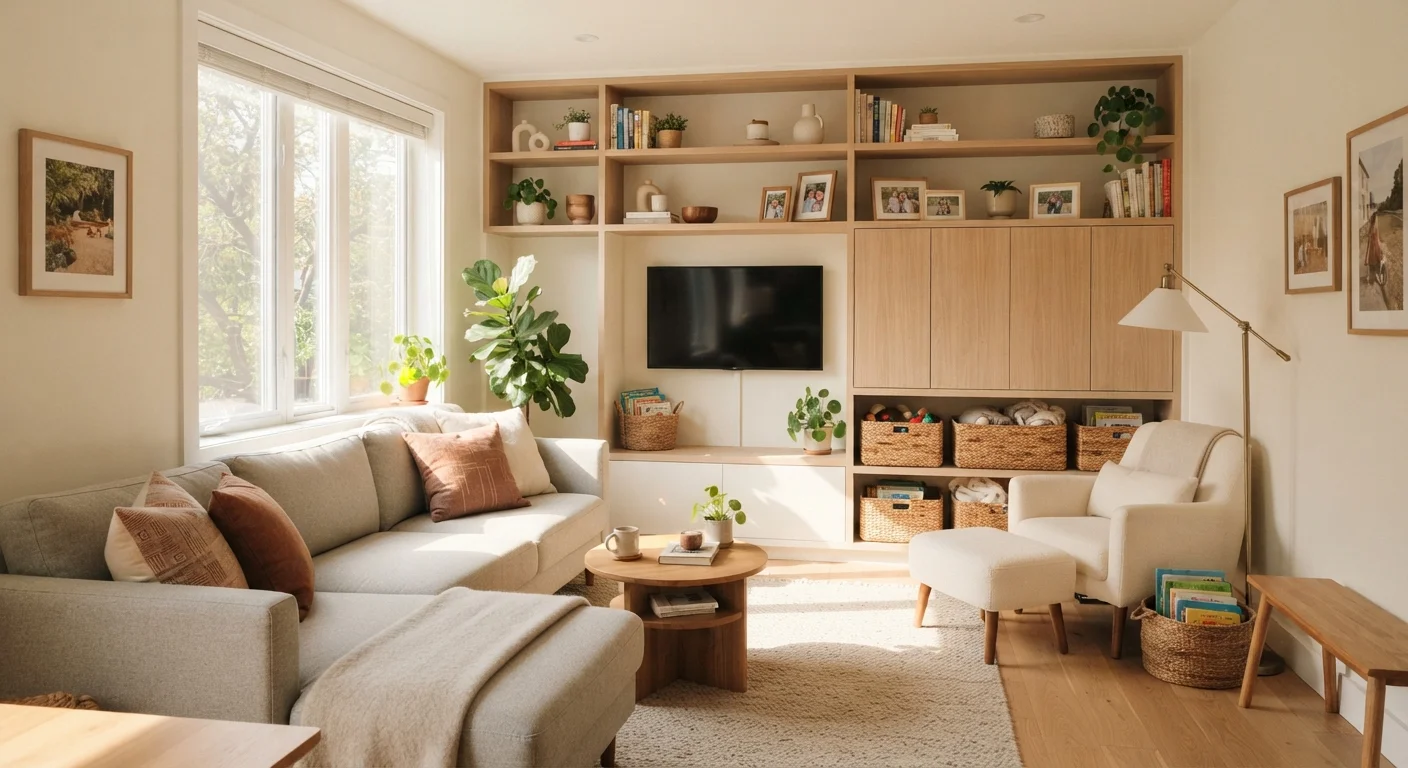
Floor space is finite, but walls extend all the way to the ceiling. Floating shelves, pegboards, and tall bookcases move storage upward and free up the floor for living. In a child's bedroom, a floor-to-ceiling shelving unit can hold books, bins, and folded clothes in one footprint that would otherwise need a dresser and separate bookcase.
In kitchens, a mounted rail with hooks keeps utensils, spice jars, and small baskets off the counter. In mudrooms or entryways, hooks at both adult and child height mean backpacks and coats land where they belong rather than on the nearest chair.
Walls extend to the ceiling; use that height before buying another floor-level piece.
Choose furniture that stores
In a compact home, a piece of furniture that does only one job is a luxury. An ottoman with internal storage replaces both a coffee table and a toy bin. A bed frame with drawers underneath removes the need for a dresser entirely in a small bedroom. A bench at the foot of a bed or near the front door can hold blankets, shoes, or sports gear inside while serving as seating on top.
When shopping for replacement pieces, storage capacity should be part of the evaluation alongside price and size. A slightly larger upfront cost for a storage bed, for example, often saves money compared to buying separate storage units later.
A piece of furniture that serves two purposes takes up one footprint, not two.
Assign every item a fixed home
The most common cause of clutter is not too much stuff; it is stuff without a designated place. When an item has no assigned spot, it lands wherever there is room, which usually means a counter, a chair, or the floor. Fixing a location for every category of item, scissors always in the desk drawer, keys always on the hook by the door, eliminates the daily search-and-scatter cycle.
This approach works best when the assigned location is where people naturally reach for the item. If the scissors are used at the kitchen table, store them in the kitchen. Locations that fight against how the family already moves will not stick.
An item without an assigned spot will always end up on the nearest flat surface.
Label storage clearly, especially in shared spaces
Labels do two things: they tell family members where something lives, and they prevent the wrong items from drifting in and making a bin or shelf unusable. In a shared kids' room, labeled bins by category (art supplies, building blocks, dress-up clothes) make tidying straightforward enough for children to do without help.
Handwritten labels on masking tape work fine. Pre-printed label makers produce a neater result, but the format matters far less than whether the label is clear, readable, and placed where someone can see it before opening the container. In pantries, labeling shelf sections rather than individual containers is faster to maintain as stock rotates.
A label on a bin tells every family member where things go, not just the person who organized it.
Declutter on a schedule, not just when it gets bad
Reactive decluttering, waiting until a space is unusable before sorting it out, means the problem is always bigger than it needs to be. A short, regular declutter session is easier to maintain than an annual overhaul. Many families find that a monthly or seasonal pass through one area at a time keeps volume manageable.
A practical rule for clothing and toys: if something has not been used in six months and has no clear seasonal purpose, it is a candidate for donation or removal. Children's items cycle out especially fast as sizes and interests change. Removing items steadily means the storage systems you build stay functional instead of overfilling within a year.
A short monthly pass through one area prevents the annual overhaul no one wants to do.
Use the backs of doors and cabinet doors
The back of a door is a storage surface that most households ignore. Over-the-door organizers work in bedrooms for shoes, in bathrooms for toiletries, in pantries for snacks or cleaning supplies, and on the inside of cabinet doors for pot lids, foil boxes, or small tools. The footprint is zero because the door itself takes up no additional space.
For households where floor space in bathrooms is especially limited, a door-mounted organizer can hold enough daily-use items to clear a cluttered vanity entirely. The main limit is door clearance: check that the organizer does not prevent the door from closing against the frame or opening fully.
The back of a door is storage space already in your home, with no additional footprint required.
Consolidate paperwork into one managed spot
Paper is one of the fastest ways a small home loses order. School forms, medical documents, bills, and manuals accumulate quickly without a clear intake system. A single designated spot, a wall-mounted folder, a desktop tray, or a small binder system, prevents paper from spreading to counters, tables, and drawers throughout the house.
A simple three-category sort works for most families: action needed, file, and shred. Processing incoming paper into one of those three categories the same day it arrives keeps the pile from building. For families managing health documents specifically, the same filing discipline applies to keeping organized health records for every household member.
Paper spreads to every flat surface unless it has one fixed entry point with a clear next step.
Keeping the system running day to day
Storage solutions only hold up when the whole family uses them. Pairing a good physical setup with shared household routines is what makes the difference between a system that lasts and one that unravels in two weeks. The household chore system guide has practical advice on distributing responsibilities across family members so no one person carries the full load.
For seasonal items like holiday decorations, winter gear, or garden tools, a room-by-room seasonal upkeep reference can help you time swaps so stored items do not pile up and disrupt the spaces you use daily.
Start with one room, not the whole house
Trying to organize every space at once leads to abandoned projects and more mess mid-process. Pick one room or even one problem area, finish it completely, then move to the next. The finished space gives the whole family a working example of what the system looks like, which makes adopting it elsewhere easier.
Organization at home also extends to records and paperwork. A system for tracking family health records and keeping a first-aid kit properly stored are two household tasks that benefit from the same labeled, assigned-location approach described throughout this article.