

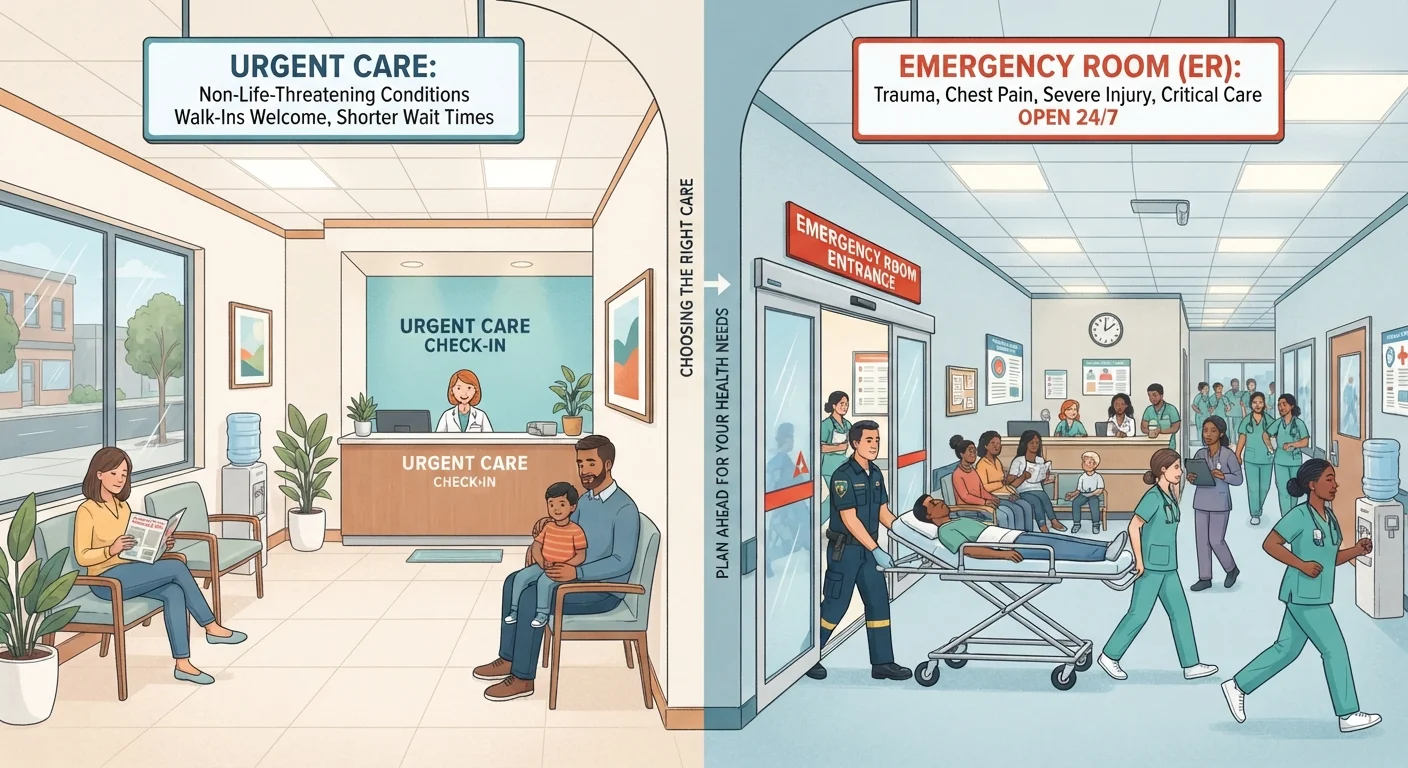
Key Takeaways
Option A
Urgent Care Center
The accessible, walk-in option for non-life-threatening conditions.
Best for: Families needing same-day treatment for illnesses or minor injuries that are not medical emergencies.
Option B
Emergency Room
The full-service facility for serious, potentially life-threatening situations.
Best for: Anyone experiencing symptoms that could indicate a life- or limb-threatening medical emergency.
If your child has a high fever, ear pain, or a minor cut that needs stitches
Urgent Care Center
Urgent care clinics handle these common childhood complaints quickly and at a lower cost than an ER, with no appointment needed.
If someone is experiencing chest pain, difficulty breathing, or signs of stroke
Emergency Room
These symptoms require immediate diagnostic equipment, specialist access, and monitoring that only a hospital emergency room provides.
If you need care after your primary care office closes
Urgent Care Center
Most urgent care locations operate evenings and weekends, making them a practical alternative to waiting for a next-day appointment.
If a family member has a severe allergic reaction or uncontrolled bleeding
Emergency Room
Anaphylaxis and significant blood loss are time-sensitive emergencies that need the full resources of an ER, including IV medications and surgery readiness.
If you are managing costs and have a non-urgent health concern
Urgent Care Center
ER copays and facility fees are typically far higher than urgent care visits, and insurers may not cover ER use for conditions that could have been treated elsewhere.
What each facility is designed to do
Urgent care centers are walk-in clinics that treat illnesses and injuries that need attention today but are not threatening to life or limb. Think of strep throat, a sprained ankle, a mild asthma flare, or a cut that needs a few stitches. Most centers have on-site X-ray machines and can run basic lab panels, so patients usually leave with a diagnosis and, if needed, a prescription.
Emergency rooms are hospital departments built to handle the full spectrum of medical crises, from heart attacks and strokes to major trauma and severe allergic reactions. They are staffed 24 hours a day with physicians, nurses, and specialists, and they have imaging suites, operating rooms, and intensive care units immediately accessible. Because of that infrastructure, they prioritize patients by severity rather than arrival order, which means a non-urgent complaint will wait behind every critical case that arrives.
This structural difference shapes both the experience and the cost. Patients who arrive at an ER with a sinus infection may wait several hours and receive a bill that is three to five times higher than an urgent care visit for the same concern. Conversely, a patient who tries to manage chest pain at an urgent care clinic risks a dangerous delay in receiving the imaging and cardiac monitoring only a hospital can provide.
This article provides general health information for educational purposes only and is not a substitute for professional medical advice. If you are unsure whether your situation is an emergency, call 911 or seek emergency care immediately.
Comparing urgent care and emergency rooms side by side
The table below outlines the main practical differences families should understand before a health concern arises. Reviewing it in advance makes the decision faster in the moment.
| Criterion | Urgent Care Center | Emergency Room |
|---|---|---|
| Conditions treated | Non-life-threatening illnesses and injuries | Serious, potentially life-threatening conditions |
| Hours | Typically extended hours; not always 24/7 | Open 24 hours a day, 7 days a week |
| Wait time | Generally shorter for minor issues | Prioritized by severity; can be long for non-critical cases |
| Average cost | Lower copays and facility fees | Significantly higher copays and facility fees |
| On-site diagnostics | X-ray and basic labs at most locations | Full imaging, labs, and specialist access |
| Appointment needed | Walk-in, no appointment required | Walk-in, triaged by severity on arrival |
Cost is one of the clearest distinctions. ER facility fees alone can run into hundreds of dollars before any treatment is billed. Many health insurance plans also apply a higher copay for ER visits unless the patient is admitted or the condition qualifies as an emergency under plan terms. It is worth reviewing your family's plan to understand how each type of visit is classified. For guidance on keeping a financial cushion for unexpected medical costs, see our guide to building a family emergency fund.
Symptoms that belong in the emergency room
Some symptoms should always prompt a call to 911 or an immediate drive to the nearest ER. These include chest pain or pressure, sudden numbness or weakness on one side of the body, slurred speech, severe difficulty breathing, a seizure, loss of consciousness, suspected poisoning, a head injury with confusion or vomiting, uncontrolled bleeding, and severe allergic reactions that affect breathing or cause significant swelling.
Children add some additional considerations. A fever above 104 degrees Fahrenheit, a febrile seizure, difficulty breathing, a stiff neck with fever, or any infant under three months with a fever above 100.4 degrees Fahrenheit warrants emergency evaluation, not a wait at an urgent care clinic. Parents of infants and young children should discuss threshold symptoms with their pediatrician in advance so they already have a framework before a stressful moment arrives.
Having your family's medical history organized and accessible can help ER staff treat your child faster. Our family health record guide explains what information to collect and keep ready.
When urgent care is the smarter choice
Urgent care is appropriate for conditions that are genuinely uncomfortable or functionally limiting but are not emergencies. Common examples include urinary tract infections, ear infections, sore throats, pink eye, mild to moderate skin rashes, minor burns, sprains, simple fractures of fingers or toes, and flu symptoms in otherwise healthy adults.
Many urgent care centers also offer services that used to require a separate appointment, such as occupational health screenings, school physicals, and travel vaccinations. Before your visit, confirm what the specific clinic can handle, since capabilities vary by location.
One practical note: urgent care is not a replacement for preventive or primary care. Routine checkups, chronic disease management, and vaccinations are better handled through a regular primary care provider. Our article on preventive care for the whole family explains what routine care covers for every age group. A well-stocked family first-aid kit can also help you manage truly minor concerns at home before they escalate.
~145 million
Annual U.S. emergency department visits
The Centers for Disease Control and Prevention reports roughly 145 million ER visits per year in the United States, with a significant share for conditions that could be treated in lower-acuity settings.
3x to 5x
Typical ER cost premium over urgent care
Health policy researchers have documented that treating the same low-acuity condition in an ER can cost three to five times more than treating it at an urgent care center, according to published analyses in health economics literature.
Over 10,000
Urgent care centers operating in the U.S.
The Urgent Care Association estimates more than 10,000 urgent care centers currently operate across the United States, expanding access in many communities.