

Key Takeaways
Start here
Why children's mental health matters early
Next
Behavioral and emotional signs to notice
Then
How to start the conversation at home
When you're ready
When to seek professional support
Finally
Building a supportive home environment
Why children's mental health matters early
Mental health is part of overall health at every age. For children, emotional and psychological wellbeing shapes how they learn, form relationships, and handle everyday stress. Conditions like anxiety, depression, and attention disorders are not rare: the CDC estimates that approximately 1 in 5 children in the United States experiences a diagnosable mental health condition at some point during childhood.
Despite how common these conditions are, many go unaddressed for years. Stigma, limited access to care, and uncertainty about what is "normal" all contribute to delayed recognition. Families who understand basic warning signs and know how to open a conversation are better positioned to connect children with support before difficulties compound.
This article is general health information, not medical advice. For concerns about a specific child, a qualified healthcare provider is the right point of contact.
Mental health condition
A pattern of thoughts, feelings, or behaviors that causes significant distress or interferes with daily functioning, and that meets criteria used by healthcare professionals to guide diagnosis and treatment.
Internalizing behaviors
Emotional difficulties that children direct inward, such as withdrawal, sadness, or excessive worry, which are often less visible than acting-out behaviors and can go unnoticed longer.
Externalizing behaviors
Difficulties that children express outwardly, such as aggression, defiance, or impulsivity, which are generally more visible to adults and often prompt earlier attention.
Developmental norms
The range of behaviors, emotions, and skills that are typical for children at a given age. Understanding norms helps distinguish ordinary variation from patterns that may need attention.
Sliding-scale fee
A payment structure in which a provider charges less to clients with lower incomes, making services more accessible to families with limited financial resources.
Behavioral and emotional signs to notice
Children rarely say outright that they are struggling. Instead, distress often appears as changes in behavior, mood, or physical complaints without a clear medical cause. The following patterns, especially when persistent or intensifying over several weeks, are worth discussing with a pediatrician or mental health professional.
- Prolonged sadness, irritability, or tearfulness that does not lift
- Withdrawal from friends, family, or activities the child previously enjoyed
- Significant changes in sleep: difficulty falling asleep, frequent nightmares, or sleeping far more than usual
- Changes in appetite or unexplained physical complaints such as stomachaches or headaches
- Declining school performance or sudden disinterest in learning
- Intense, hard-to-redirect worry about everyday situations
- Increased aggression, defiance, or emotional outbursts beyond what is developmentally typical for the child's age
- Regression to younger behaviors, such as bedwetting in a child who was previously dry
No single item on this list is a diagnosis. Context matters. A child going through a family transition may show some of these signs temporarily. Persistence, severity, and interference with daily life are the factors that move a concern from ordinary adjustment to something worth professional attention.
How to start the conversation at home
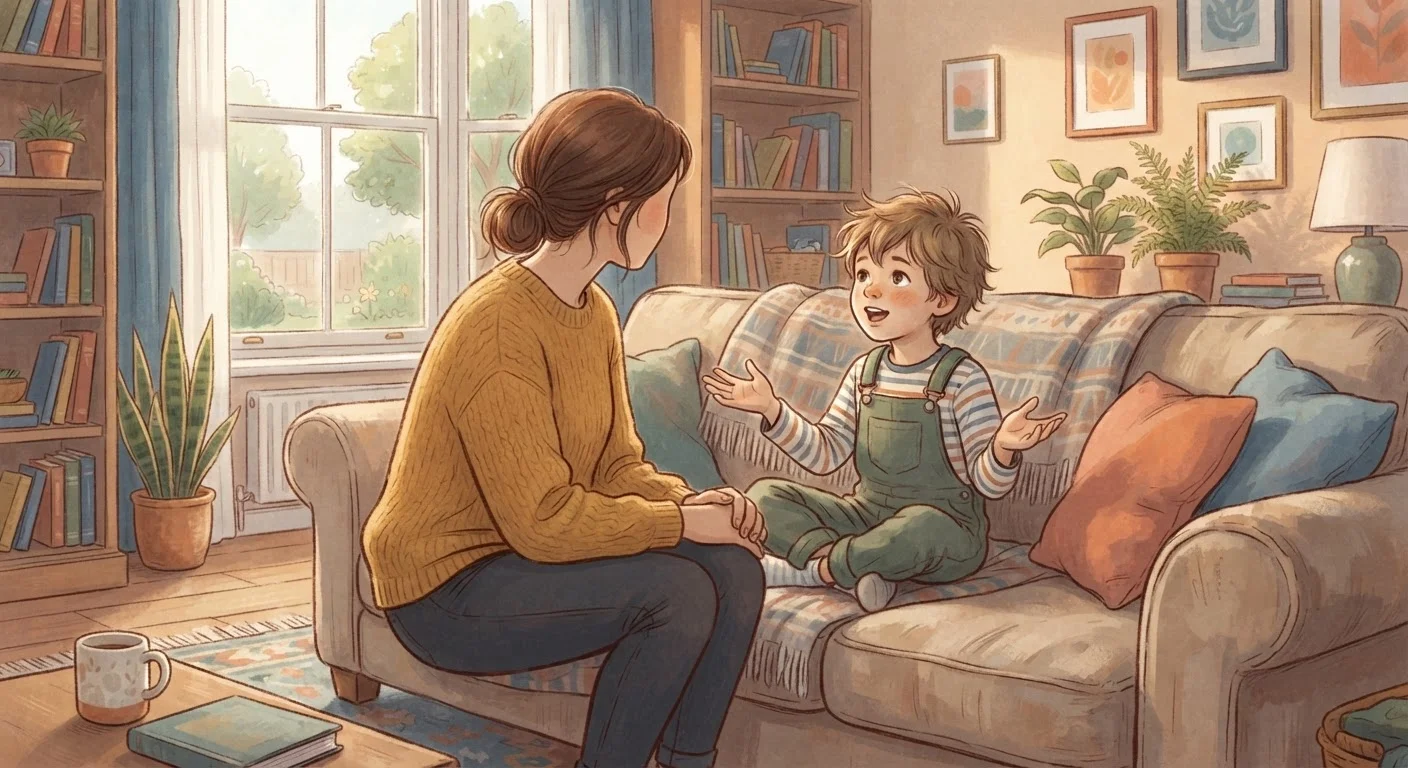
Many parents worry that raising the topic of mental health will alarm their child or put ideas in their head. Research in child psychology does not support this concern. Children benefit from knowing that feelings, including difficult ones, are normal and that help is available.
Practical approaches that tend to work:
- Choose low-pressure moments. Conversations in the car, during a walk, or while cooking often feel less confrontational than a formal sit-down talk.
- Ask open questions. "What was the hardest part of your day?" invites more than "Did anything bad happen?"
- Name emotions without judgment. Saying "It sounds like you felt left out" validates experience without minimizing or fixing it immediately.
- Share your own manageable experiences. Briefly mentioning that you sometimes feel nervous or sad normalizes emotional experience without burdening the child.
- Stay consistent. One conversation is rarely enough. Regular, brief check-ins over time build the habit of openness.
Teaching children that emotional health deserves attention the same way physical health does is a practical long-term investment. Families who discuss feelings routinely tend to find that children are more willing to speak up when something is genuinely wrong.
When to seek professional support
A pediatrician is often the most accessible starting point. At routine well-child visits, many pediatricians screen for depression, anxiety, and developmental concerns using standardized tools. Parents can also raise concerns directly without waiting for a scheduled screening.
If a pediatrician recommends further evaluation, they may refer to a child psychologist, psychiatrist, licensed clinical social worker, or other mental health professional. School counselors are another practical first contact, particularly for concerns that center on school behavior or friendships.
Bring notes to the appointment
Before visiting a pediatrician about behavioral or emotional concerns, write down specific examples: what the behavior looks like, how often it occurs, and how long it has been happening. Concrete details help the provider assess the situation more accurately than general descriptions like 'seems off lately.' This preparation makes the visit more productive for both parent and clinician.
For families managing costs, several options can reduce financial barriers:
- Community mental health centers typically offer sliding-scale fees based on income.
- Federally Qualified Health Centers (FQHCs) provide mental health services regardless of ability to pay.
- Children enrolled in Medicaid or the Children's Health Insurance Program (CHIP) generally have access to mental health benefits.
- Many school districts offer free counseling or social-emotional support services.
Consulting a professional is not a sign of parenting failure. It is a practical health decision, the same as taking a child to a doctor for a persistent cough.
Building a supportive home environment
Professional care is sometimes necessary, but the home environment shapes children's mental health every day. A few consistent habits can make a meaningful difference over time.
Predictable routines reduce anxiety because children feel safer when they know what to expect. Regular sleep schedules, consistent mealtimes, and structured after-school time all contribute to emotional stability. Physical activity, adequate sleep, and balanced nutrition support mood regulation in ways that are well-documented in pediatric research.
Limiting exposure to distressing news or adult financial worries is also reasonable, though completely shielding children from all stress is neither possible nor ideal. Age-appropriate honesty, paired with reassurance about what the family is doing to manage a situation, tends to work better than silence. Families already thinking about long-term wellbeing from multiple angles may find it useful to explore related topics: see our guide to teaching kids about money at every age for practical ideas on building resilience through financial literacy alongside emotional skills.
Modeling healthy emotional habits, acknowledging your own stress in age-appropriate ways, and apologizing when you lose patience all communicate that emotional health is something the whole family works on together.
This article is for general informational purposes only and is not a substitute for professional medical advice, diagnosis, or treatment. Always consult a qualified healthcare provider with questions about a child's mental or physical health.